

A dueling piano show lives or dies on how close the audience is to the pianos. That single fact drives every setup decision: whether you need a stage, what shape your tables should be, whether to put in a dance floor, and when dinner needs to be finished.
One of the reasons HiFi Productions puts on successful shows time after time is that I personally talk through room setup with clients before every single show. Here is everything I would cover with you, in the order you will probably decide it.
The Short Version
If you only read this far, these are the requirements:
- No dance floor between the pianos and the audience.
- Rectangle tables if the venue has them, positioned with the short end facing the performance area.
- A stage only if you are expecting more than 300 guests. Required over 400.
- Dinner finished, or nearly finished, about 10 minutes before we start.
- Heavy hors d’oeuvres tables closed and torn down 10 minutes before showtime.
Everything below is why.
Start With Your Crowd Size
Nearly every other decision follows from how many people you are expecting. We have played for as few as 20 and as many as 1,200, and the sweet spot is somewhere between 100 and 300. I have written separately about what makes a good crowd size for dueling pianos, and it is worth reading before you finalize your guest list and your room.
Do You Need a Stage?
Usually a stage is not required, but it can be nice to have.
My first question is always how many people you are expecting. If the answer is over 300, a stage is highly recommended. Over 400, a stage is required.
If you are having one, the dimensions matter
The minimum stage size for our show is 20 feet across and 12 feet deep. Ideally the height will not be more than 24 inches, and 16 inches is probably best.
The height limit is not arbitrary. We want to be accessible to your guests so they can reach the pianos to place request slips. The more we can make dueling pianos feel like we are playing in someone’s living room and are just part of the party, the better. A tall stage undoes that.
Sometimes we would rather be on the floor
At a venue with a built-in stage we sometimes prefer to be on the ground anyway. That stage might be in a less desirable part of the room, or it might be too high. In those cases we would rather play at ground level, or if there are over 300 people, look at bringing in a portable stage.
We usually do not turn down a stage if it is offered, and they can be a nice addition for any size of group. Just keep placement and sizing in mind.
Table Shape Matters More Than You Would Think
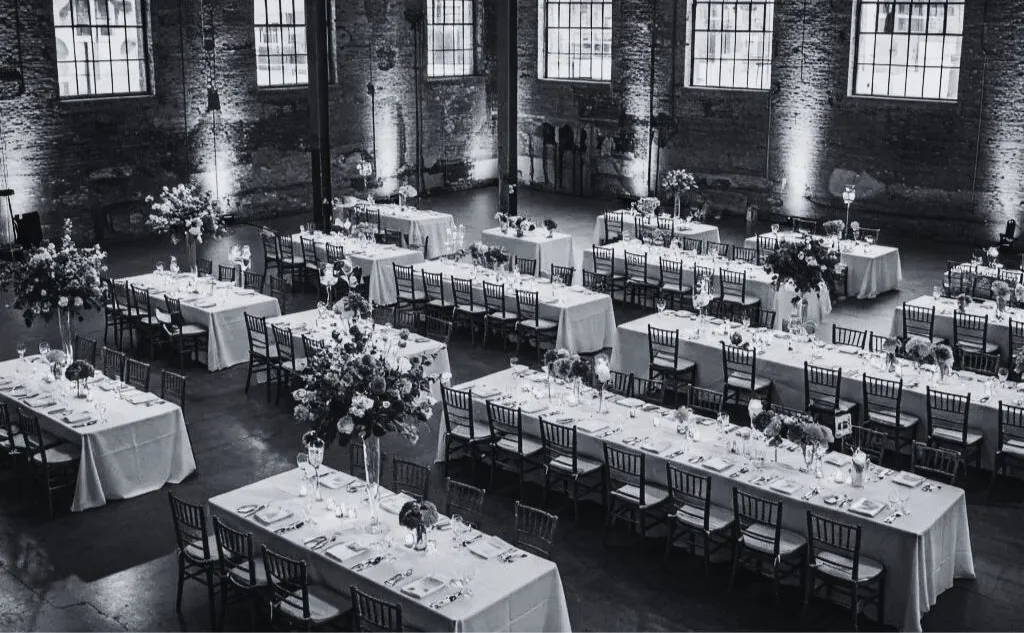
Have you ever been to an event with a speaker, presentation, or performance on a stage? You have a table number, and when you sit down you know the best seat at a round table is the one already facing the stage.
When I attend those events as somebody’s guest, I always try to take the worst seat out of consideration for my host. Then the presenter takes the stage and I have the awkward decision: turn my chair all the way around, or do some kind of half turn and crick my neck for an hour.
That is exactly the problem with round tables at a performance. Half the guests have to turn their chairs around, and once they do they cannot engage with the other people at their table. Dueling pianos is such a socially engaging form of entertainment that we want people to watch us comfortably and still enjoy the company of the people they are sitting with.
Rectangles solve it
We find the most success holding a crowd when there are rectangle tables. They let everybody have the same view while only slightly angling their chairs. Position them so the short end of the table is parallel with the performance area and you get a clear sightline for everyone.
As a bonus, rectangle tables use space more efficiently and allow more seating capacity. They can also work better for the overall flow of a room, especially if you have servers moving through it.
And if your venue only has rounds, that is fine
A lot of venues only have round tables, and more often than not we are playing in a room with them. My goal here is just to make you think of the possibility, because that is usually the actual problem. Nobody thinks to ask whether rectangle tables are an option.
Think outside the circle.
Please Do Not Put In a Dance Floor
It might seem natural to think that live music encourages dancing, and dancing requires a dance floor. In most cases you would be 100% correct. For dueling pianos specifically, a dance floor works against everything we are trying to do.
In dueling pianos we are going for overall crowd participation. That is the major thing separating our show from a more traditional live band. On almost every song we are asking the audience to be engaged: clapping along, singing a chorus completely by themselves, sometimes getting pulled up to do a dance or rock a cowbell.
A dance floor in front of us creates separation, and we do not want that. We want to be right next to the audience. We want to hear them singing and engage with people during and between songs.
Have you ever been to a dueling piano bar? Did you notice there was no dance floor? I have learned across hundreds of shows that having one in front of us makes the crowd feel an ocean away, and it hinders participation enormously. And since this is not a dance-driven show, we would not have many dancers out there anyway.
This is not a ban on dancing
I am by no means saying dancing is banned at our shows. We follow where the show naturally takes us, and on a few songs a group of people might break out into some funky dance moves, which is totally awesome. It is just not the focus, and the separation a dance floor creates is not worth it.
If a packed dance floor is what you are picturing for your event, I would honestly encourage you to consider a DJ or a live band instead. There is a reason our dueling piano show has the reputation it does, and it is not because we pack dance floors. It is because we engage people and leave them with a different kind of experience. The same reasoning applies to whether dueling pianos suit a wedding.
Food, Drinks, and Timing

When you picture a fun event, whether a fundraiser, work holiday party, or birthday party, three basic elements probably come to mind: food, drinks, and entertainment. The timing between the first and the last one matters more than people expect.
A timeline that works
For a fundraiser or corporate event, a basic timeline might look like this:
- 6:00 pm – Doors open, cocktails and mingling
- 7:00 pm – Dinner served
- 8:00 pm – Show begins
- 10:00 pm – Show ends
For fundraisers there might also be a live auction sometime before we start playing. If a client brought me this timeline, I would say it looks great.
Where it goes wrong
The problem comes when dinner time is too short, or when heavy hors d’oeuvres are served throughout the night in a way that clearly overlaps our show.
As a rule, we cannot perform while most of your guests are eating. Our show relies heavily on crowd participation. When we hit the stage we want to go full on and get everybody clapping and singing as much as we can, and the start of the show really sets up how the rest of it goes.
It is hard for a person to sing with a mouthful of meatballs, or clap along while holding utensils. I have seen it too many times: we start the show, half the room is just taking their seats with a full plate, the other half is midway through a chicken dinner, and nobody participates. Then we have to back off and play boring songs until people are finished and ready to go.
We build in flexibility
I know it can be difficult to judge exactly how long it takes guests to get through a food line, or for plates to be served. We are always ready to go at least 10 minutes before the scheduled start time, or 15 minutes after it. If your venue and timeline allow, we would still be happy to play the full contracted time.
Heavy hors d’oeuvres
If you are having an hors d’oeuvres table, we ask that it be closed and torn down at least 10 minutes before we begin. If any announcements need to be made in advance so guests know, we are happy to make them, or somebody from your event can use our microphones to make it clear.
In the end we want to provide the best entertainment we can, and it helps enormously if most of the audience is done or nearly done eating before we start. That way they can sing “bah bah bah” during Sweet Caroline without spitting chunks of food on their neighbors.
One Last Thing Worth Asking About
Room setup is the biggest variable, but two other things come up on almost every planning call: how song requests and tipping work, and how we handle content and language. Both are worth settling before the day.
Planning a Dueling Piano Show?
We perform private dueling piano shows for fundraisers, corporate events, and private parties across the Wichita area, and I will walk through your room setup with you before we ever get there. Check availability and I will get back to you personally, or learn more about dueling pianos from HiFi Productions.