

At a dueling piano show, the audience picks the setlist. Not in a vague, we-take-requests way, but literally: we do not know what we are playing until slips start landing on the pianos. Understanding how that works is the difference between watching a dueling piano show and running one.
Here is how requests and tipping actually function, at a bar and at a private event, and what to write on the slip if you want your song played.
How a Dueling Piano Show Works
Two pianists and a drummer take requests from the audience all night, play them by ear, and lean heavily on crowd participation, sing-alongs, and back-and-forth between the players. There is no set list. What gets played, and in what order, is decided in real time by what the room asks for.
That is the whole appeal, and it is why requests matter so much.
Requests and Tipping at a Piano Bar
If you have ever been to a dueling piano bar, you probably caught on pretty quickly that it is customary to send up money with your requests. There might also be a phrase of the night board, or something similar, where patrons can have something they wrote displayed for a certain amount of cash. Another fun thing is bringing a special person or persons on stage to participate in a roast of some sort for a special occasion, for a stage fee.
How It Works at a Private Event
In the private party sector that we mainly work in, tips for songs are not as heavily focused on, but they can still be incorporated.
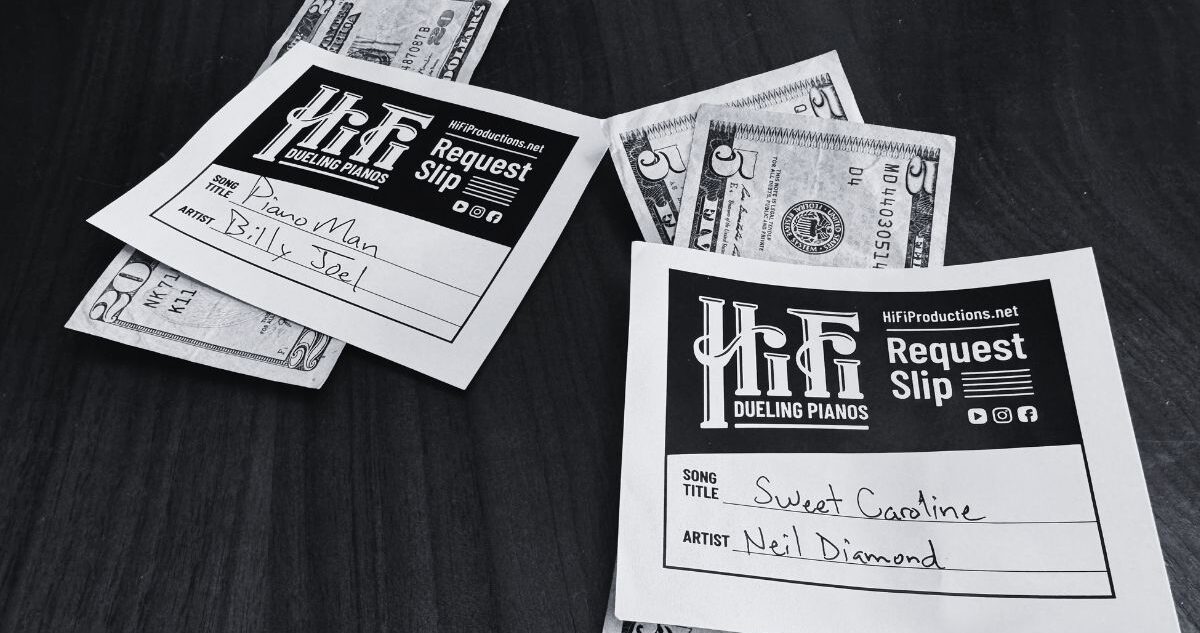
We provide request sheets and put them on all the tables before the show. These slips are brought up and set on either of our pianos during the performance, often with money and a song title on the slip. These tips, as at the bars, actually become part of the show and bring another unique element to dueling pianos that you do not see with other forms of live entertainment.
How Requests Get Prioritized
First off, tips greatly help us prioritize what songs we play and how soon we play them. If there is a $20 with it, it is probably coming up pretty quickly.
It is true that we really do not have a set list and do not know what songs we are going to play until we start getting requests on the pianos.
You can outbid a song that is already playing
There are even instances where people can outbid songs we are currently playing. I might allow that for a particularly long song, anything by Meatloaf for example, where somebody can bring up more money than we received to play it in order to have it stopped.
We might be playing a particular college fight song and somebody can bring up money to switch to another school, which can turn into a battle. Those are some of the best moments of the night, and they are entirely audience-created.
What Makes a Good Request
Since people ask: the requests that work best are not necessarily the ones you love most. They are the ones the room can get behind.
- Songs most people in the room know well enough to sing along to.
- Songs with a strong, recognizable chorus. That is what a sing-along runs on.
- Something tied to the occasion or a person in the room. A fight song, a hometown anthem, a song that means something to the guest of honor.
- Something with a story attached. Write it on the slip. We will use it.
Requests that tend to land flat are deep album cuts nobody else knows, songs that are not built for a piano and drums, and the occasional song submitted purely to see whether we will play it. More on that last category in a moment.
And if you really want your song played, the slip with money on it moves up the stack. That is not a rule we invented; it is how the format has always worked.
Fundraisers: Tips Can Go to the Cause
At private parties we generally do not make tips as big a deal as at a bar, but if we are playing a fundraiser we offer to split any money we receive with the fundraiser. That allows us to play up the money part of the show a bit more.
At the end of the night there have been several times where I have given over $1,000 back to the charity.
What If You Do Not Want Guests Tipping?
Occasionally, usually for corporate events where a company does not want employees or guests to feel obligated to spend money, we will be tipped in advance and asked not to take tips from guests. We will happily do this, but I do know our performance will be affected.
What usually ends up happening is that we are flooded with request slips, since it is free to put them up there. In that case we can just pick and choose the songs we want to play, and we lose that raw element of “oh geez, I need to play this song next, hopefully I can pull it off.” I think the show misses a little bit of an edge, and some of the fun.
The Best Solution I Have Seen
I have to share what one client did for their company Christmas party.
This client, named JT, understood the value that the tipping aspect adds to a show, but also did not want employees to feel they needed to tip. So he gave every employee $20 along with a ticket number at the beginning of the night, and required that they spend it all on song requests.
At the end of the show we split up all the tip money and did a ticket drawing for the other half of the tips to go to an employee. We have done their event twice now, and I have to say, that was a genius move by JT.
If you are planning a corporate event and want the energy of a tipping crowd without asking anyone to open their own wallet, that is the model I would copy.
Thinking About a Dueling Piano Show?
We perform private dueling piano shows for fundraisers, corporate events, and private parties across the Wichita area. If you would like to talk about your event, check availability and I will get back to you personally. You can also learn more about dueling pianos from HiFi Productions.